What is the actual cost of operational inefficiency?
It's the wages you're paying people to wait, chase, and re-explain, multiplied by how often it happens in a month. Most owners feel this cost daily but never write it down, because it doesn't show up as a line item. It hides inside salaries, inside "that's just how things work here," inside the plant head's answer when you ask why dispatch didn't happen on Tuesday: "we were waiting on approval."
You don't need a consultant's audit to price it. You need three numbers you probably already know, or can find out by Friday.
How do you calculate the cost of a delayed approval?
Multiply how often it happens, by how long it takes, by what the waiting costs.
The formula:
Monthly cost = Number of times this decision happens per month × Hours lost per instance × Loaded hourly cost of everyone waiting on it
"Loaded hourly cost" means salary plus whatever else the business pays for that person, divided by working hours in the month. It is not their take-home pay. If your production supervisor costs the business $1,600 a month all-in, and works roughly 200 hours a month, their loaded hourly cost is $8.
"Hours lost per instance" is not the two minutes it takes someone to type "approved" on WhatsApp. It's the gap between when the request was ready and when the answer arrived. That gap is where the cost lives.
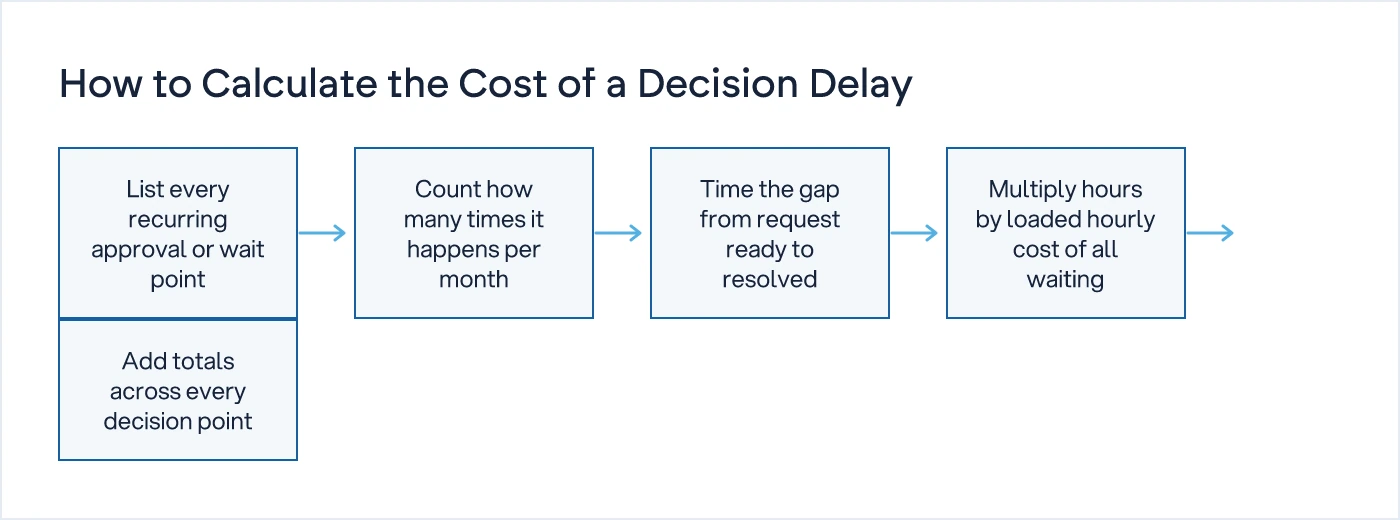
Run this for every recurring decision point where something sits waiting on a person. Most manufacturing and trading businesses find three to six of these once they actually start listing them.
What does this look like in a real business?
Take a $1.4M (roughly ₹12 crore) auto-components manufacturer, the kind with one shift, one accounts head who also signs off credit limits, and a dispatch team that moves fast when nothing is blocking it.
Three recurring decision points, tracked for one month:
Dispatch approval, credit limit override. The accounts head has to personally approve any dispatch where the customer is over their credit limit, which happens often with a handful of large accounts. He's usually on the shop floor or in a supplier meeting when the request lands, so the dispatch clerk and the sales coordinator wait. Average wait: 3 hours. Happens 40 times a month, two people waiting each time.
Purchase order sign-off. Any PO over $600 needs the owner's manual approval, and the owner travels. Average wait: 2 hours. 25 times a month, two people waiting.
Quality hold release. A batch flagged by QC can't move to dispatch until the plant head physically checks and signs the release note. Average wait: 4 hours. 15 times a month, three people effectively blocked, including the machine operator who can't start the next job on that line.
| Decision point | Times per month | Hours lost per instance | People waiting | Loaded hourly cost | Monthly cost |
|---|---|---|---|---|---|
| Dispatch approval (credit override) | 40 | 3 | 2 | $8 | $1,920 |
| Purchase order sign-off | 25 | 2 | 2 | $10 | $1,000 |
| Quality hold release | 15 | 4 | 3 | $9 | $1,620 |
| Total | $4,540/month |
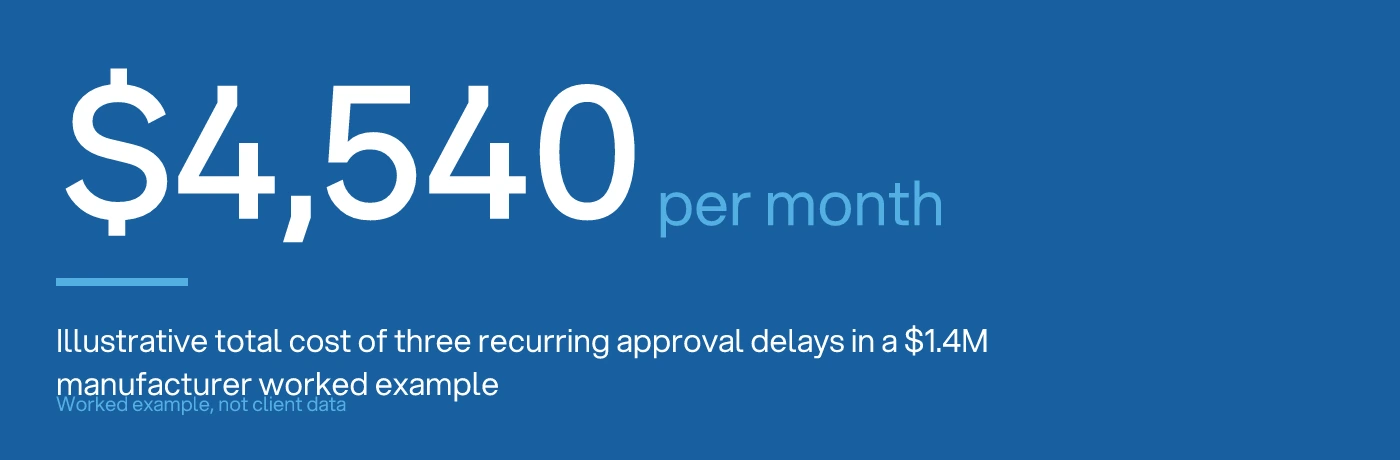
$4,540 a month, roughly $54,000 a year, from three decision points in a business with a handful of employees and a straightforward process. Not lost revenue. Not a bad quarter. Just wages paid to people while they wait for someone to say yes.
This is an illustrative worked example built to show the method, not a client figure. Run it on your own numbers and the total will be different, but the shape of the problem rarely is: a small number of decisions, made by a small number of people, sitting far longer than the decision itself takes.
Why does this number matter now?
Because input costs are rising, and most owners are already squeezing supplier terms, renegotiating freight, and watching overtime closely. Rewiring one approval habit that costs $4,500 a month is often a bigger lever than another round of vendor negotiation, and it's one the owner already controls without needing anyone else's agreement.
It also reframes a conversation that usually happens in the wrong terms. "Our dispatch is slow" invites a shrug. "We are paying $1,920 a month for two people to wait three hours for one signature" invites a decision.
Why does the delay exist in the first place?
Usually because the decision was never actually assigned to a role, only to a person, and that person is not always reachable when the decision is needed.
The accounts head who approves credit overrides is not slow. He's doing his job, on the shop floor, in a meeting, at a supplier site. The problem is that the process assumes he's at his desk, reachable, with full context, the moment a request lands. That assumption breaks a few times a week, and every break costs three hours multiplied by two people.
This is the point where owners are tempted to reach for software: an approval app, a notification system, a dashboard. Before that, ask a sharper question. Does this decision need him specifically, or does it need someone with the authority to see the same information he sees? If it's the second, the fix might be a clearer credit policy with a defined threshold, not a faster way to reach him. Do not automate a bad process. Automating a decision that shouldn't require a person at all just makes the bad process faster and harder to notice.
What should you track to keep this honest?
Four or five decision points, tracked for real, not estimated from memory.
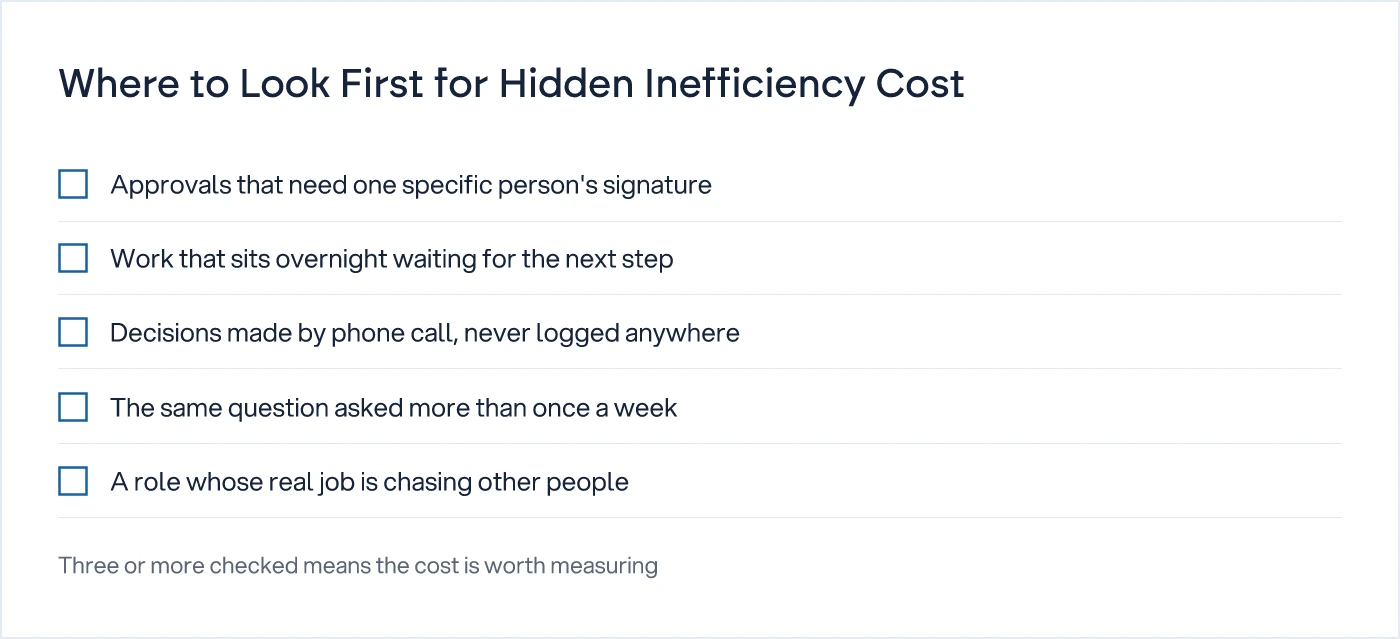
Pick the decision points that come up in every "why didn't this happen" conversation you've had in the last month. Track them for two to three weeks with a simple time-stamp: request ready at X, resolved at Y, who was involved. You'll have real numbers, not guesses, and the total will usually surprise the person who's been living with it the longest.
What to do with the number once you have it
Take the highest-cost decision point and ask two questions before touching any software. Who actually needs to make this decision, and what information do they need to make it without waiting for someone else to fetch it for them? Sometimes the answer is a clearer policy. Sometimes it's moving the authority one level down with a defined limit. Sometimes it genuinely needs a system that surfaces the request and the context together, so the decision-maker doesn't need a phone call to make the call.
That's the point where it's worth understanding how the process actually works end to end, not just the step that's visibly stuck. We understand how your business actually works first — then we design the system. A digital transformation partner whose job is process clarity before code will ask about the decision, not the dashboard. That's what the digital transformation service is built around: fixing the decision point, then, only if it's needed, building the system around it.
Next step
Pick one decision point this week. The one that comes up most often in your own "why is this late" conversations. Write down how many times it happened last month, how long each wait was, and who was involved. Multiply it out. Bring that number to the next conversation about where to spend, instead of a feeling that something is slow.