Most digital transformation strategies you'll find online are written for a business with a Chief Digital Officer, a change management budget and twelve months to run a pilot. You run a 50-person company. You don't have a transformation office. You have a production plan that slips, a sales team that calls you for every discount above 5%, and a finance person who still chases signatures on WhatsApp. This is what a digital transformation strategy looks like when it's built for a business your size, not scaled down from one that isn't.
Searches for "digital transformation strategies" have risen sharply across India, the USA, the UK and the UAE over the past year. The interest is real. What's missing is advice that fits a business with no transformation office at all.
Why don't enterprise frameworks fit a small business?
Enterprise frameworks assume layers of management, a dedicated budget line and tolerance for a two-year rollout. An SME has none of these, and doesn't need them.
A framework built for a 5,000-person company assumes a CIO who owns the roadmap, a steering committee that meets monthly, a change team that manages adoption, and a budget that survives a bad quarter untouched. In a 50-person business, the owner is the CIO, the steering committee and the change manager, usually all before lunch.
That's not a smaller version of the same problem. It's a different problem. Digital transformation in business, at SME scale, has to work with one decision-maker, one or two people who actually understand how work crosses departments, and a return that shows up within months, not years.
This is also why so much digital transformation strategy content doesn't land for owners. It solves a coordination problem large companies have and small companies don't. What a small company has instead is an owner who is the only person who sees the whole picture, which carries its own cost. If that sounds familiar, it's worth reading why the business can't run without you alongside this.
What does a digital transformation strategy actually mean for an SME?
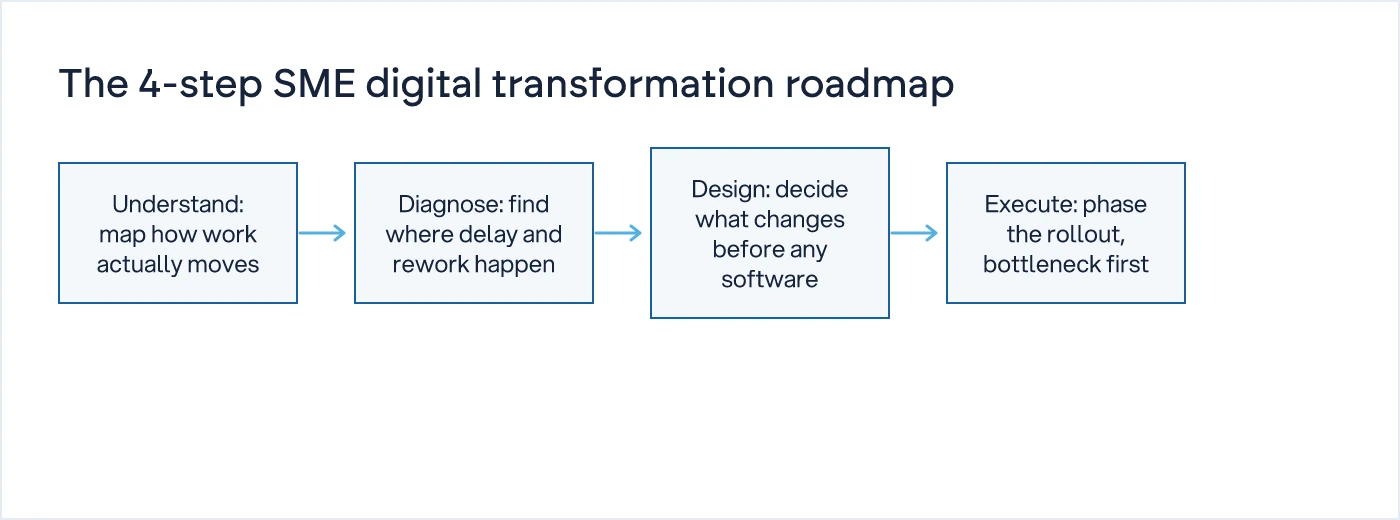
It means deciding, in order, what to understand, what to fix, what to redesign, and what to build, before any software gets chosen. Most SME projects go wrong because that order gets reversed.
A 50-person textile exporter in Gujarat and a 40-person logistics firm in Bangkok face different operations, but the same sequence applies to both: understand how work actually moves today, find where it breaks, design what should change, then build or configure the system around that design. Skip the first two steps and you end up automating the same delays you had before, just with a login screen on top.
What happens in each of the 4 steps?
Each step answers a different question, and each one has to finish before the next begins.
Step 1: Understand
This step answers one question: how does work actually move through the business right now, not how the org chart says it should.
Walk one real transaction end to end. A purchase order from request to payment. A customer order from enquiry to dispatch. Who touches it, in what order, and where does it wait. In most SMEs, nobody has mapped this in five years, because the owner has been holding the map in their head.
Step 2: Diagnose
This step answers: where exactly does the delay happen, and what does it cost.
If a purchase order takes four days to get approved, find out why. Is it sitting on one desk. Is the approver travelling. Is the information needed to approve it scattered across three people. Diagnosis isn't about blame. It's about naming the specific step that causes the wait, so you're not fixing the wrong thing later.
Step 3: Design
This step answers: what should the process look like, before anyone talks about software.
This is where most SME projects should spend more time than they do. Decide who approves what, at what value, with what information in front of them. Decide what gets automated and what gets removed entirely. A process that takes six approvals to release a job card for stitching 50 units probably needs fewer steps, not a faster version of six steps.
Step 4: Execute
This step answers: what gets built or configured first, and in what order.
Execution starts with the costliest bottleneck, not the easiest one to automate. A distribution company in Dubai might start with purchase order approvals. A manufacturer in the US Midwest might start with production scheduling. The sequence depends on where the business is actually losing time and money, which is exactly what steps 1 and 2 told you.
Quick wins vs foundation work: which goes first?
Quick wins build trust in the project. Foundation work is what makes the quick win last. You need both, in the right order.
A quick win might be automatic WhatsApp or email alerts when a purchase order has sat unapproved for 48 hours. It takes days to set up and the relief is immediate, because the purchase team stops calling the owner's PA to ask where things stand. That's a real improvement, and it's worth doing early.
But if the approval process itself is broken, if every order above $200 (₹16,000) needs the owner's signature regardless of risk, the alert just notifies people faster that the same bottleneck exists. The foundation work, redefining who can approve what and at what value, is slower and less visible, but it's what makes the quick win stick instead of becoming one more unread notification.
In India, the government has been pushing infrastructure that small businesses can plug into rather than build themselves. On MSME Day in June 2026, India launched platforms including PMEGP 2.0, Samadhaan 2.0 and MSME Global Mart 2.0 on ONDC, aimed squarely at digital transformation for MSME businesses that don't have in-house technology teams. Using infrastructure like this, where it fits, counts as a legitimate quick win. It doesn't replace the foundation work inside your own four walls.
How do you measure progress once you start?
Measure the things that change your week, not the things that look good in a vendor's dashboard. Owners care about fewer follow-up calls, faster decisions and less time spent approving things a system should handle alone.
| KPI | What it tells you | How often to check |
|---|---|---|
| Time to close a purchase order | Whether approvals are moving or stuck | Weekly |
| Owner hours spent on routine approvals | Whether decisions are shifting to the right level | Monthly |
| % of orders dispatched on the planned date | Whether production and dispatch are in sync | Weekly |
| Days sales outstanding | Whether payment follow-up is working | Monthly |
| Stock discrepancy rate at physical count | Whether the system reflects the shop floor | Quarterly |
If none of these move within the first 90 days of execution, the design step was rushed, or the wrong bottleneck was chosen first. Either way, it's worth stopping to check before building further on top of it.
Why does digitising a bad workflow fail?
Because the software makes a broken process faster, not better. A four-day approval delay becomes a four-day approval delay with an app.
A piece in Daily Maverick, published in February 2026, made the same point plainly: most digital initiatives fail because the workflow itself never changed, only the tool wrapped around it did. That matches what shows up inside most SME operations. The purchase order still needs six signatures. The job card still gets created from memory. The system just records the delay instead of removing it.
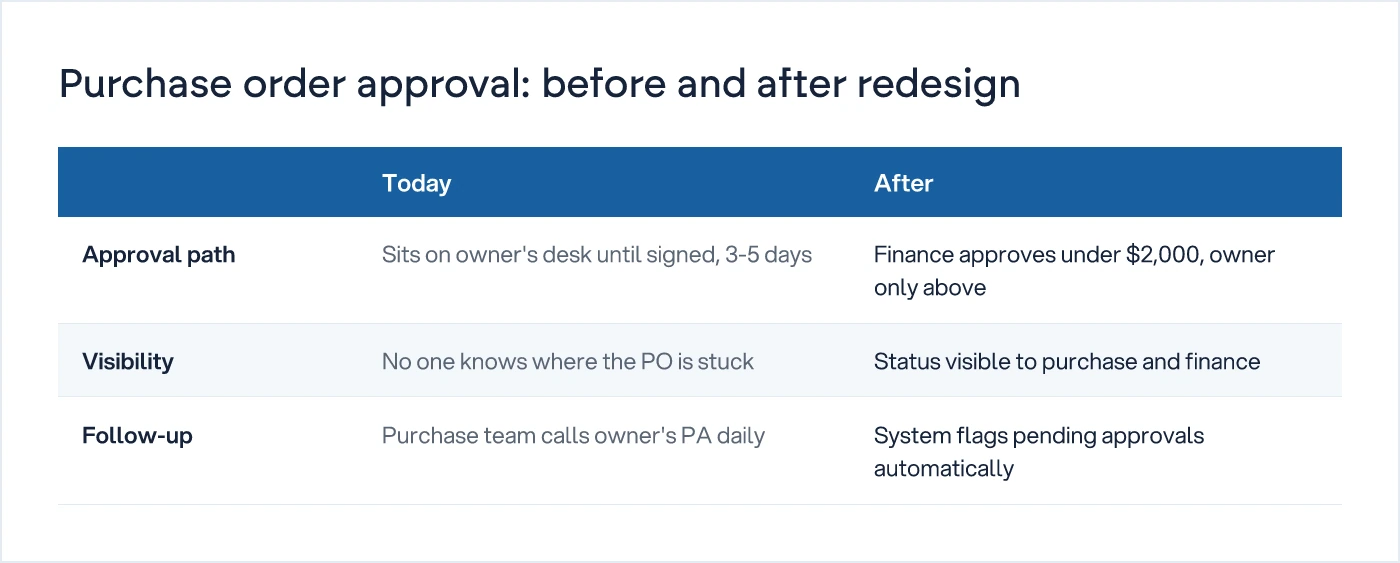
The fix isn't a better system. It's redesigning the approval path first, then building the system around the new path. This is the entire argument for doing steps 1 to 3 properly before step 4 starts. Do not automate a bad process. If the answer to "where is my order" still needs a phone call to find out, nothing has actually changed, whatever software sits underneath it.
This is also where a lot of SME digital transformation spend gets wasted. Money goes into licences and customisation for a process nobody questioned, and six months later the same person is still the only one who can unstick a stuck order. A checklist for evaluating ERP vendors is useful once the process is designed. It's the wrong place to start.
What should an SME do first?
Start with one process, not the whole business. Pick the one causing the most pain this month, the one you get asked about daily, and walk it end to end yourself before anyone suggests a tool.
If you're not sure where to begin, a free 30-minute call is the lowest-commitment way to talk through which process to start with. For businesses that want a structured, on-site look at where the delays actually sit, SCAN (System Clarity & Actionable Needs) is the next step after that call, a paid diagnostic that maps the real workflow before any system gets designed.
We understand how your business actually works first, then we design the system. That order doesn't change whether you're a 30-person trading company in Riyadh or a 200-person manufacturer in Ohio. For more on what this looks like end to end, the digital transformation hub has the full set of guides, including when it's actually the right time to start.