What does "AI-ready" actually mean, if it isn't about buying a tool?
It means a specific decision inside your business, and the data behind it, is clean and structured enough that a machine could reliably inform that decision instead of guessing at it. Nothing more than that.
Most owners hear "AI in operations" and picture a dashboard, a chatbot, a demand forecast that appears on a screen. The vendor conversation always starts with the tool. That is the wrong end of the problem. The tool is the last five percent of the work. The first ninety-five percent is whether the decision the tool is meant to support is even clearly defined, and whether the numbers feeding it can be trusted by the person who has to act on them.
A vendor will show you a demo built on clean, complete, well-labelled data. Your business runs on Excel sheets three people update differently, a Tally export, and a WhatsApp group where half the actual order changes happen. The gap between the demo and your reality is where AI projects stall, not at the algorithm.
What decision would AI actually inform, and who makes it today?
Before you take a vendor call, name the decision. Not "better visibility" or "smarter operations", the actual decision, made by the actual person, on a schedule you can point to.
For a manufacturer, that might be: how much of Product Line B to run next month, decided by the production planner based on the sales manager's estimate and last month's dispatch register. For a trading firm, it might be: which customers to extend credit to this quarter, decided by the finance head based on an ageing report that is usually two weeks out of date.
Write down three things before any vendor conversation:
- The exact decision.
- Who makes it right now, and how often.
- What information they currently use to make it, and where that information physically lives.
If you cannot fill in all three without a phone call to three different people, the decision itself is not yet well-defined enough for AI to inform it. That is not a technology gap. It is a process gap, and it existed before anyone mentioned AI.
Is your data clean enough, or just present?
Most businesses have plenty of data. Very little of it is structured the same way twice, which is a different problem entirely.
"We have years of sales data" usually means years of sales data spread across formats, spellings, and systems that don't talk to each other. A forecasting tool cannot use data it cannot reconcile. Here is the difference that matters before you spend on anything:
| Dimension | Data that exists | Data that's AI-ready |
|---|---|---|
| Format | Spread across Excel, Tally, WhatsApp, paper registers | Held in one system, same fields captured every time |
| Identifiers | Customer and product named differently by each person entering it | Every customer, product, and order carries one fixed code |
| History | Last two or three months easily found, the rest archived or lost | 18-24 months of consistent, dated records |
| Ownership | Whoever entered it last can edit it without a trail | One named person accountable for accuracy |
| Update timing | Entered whenever someone remembers to | Entered the same day, every day, without exception |
If most of your answers land in the left column, that is the actual project. Cleaning and structuring that data is real, billable, valuable work, and it should happen whether or not you ever buy an AI tool. It fixes the visibility problem today, with or without a model sitting on top of it.
What's the five-minute check before you take a vendor call?
Run this before you agree to a demo, not after.
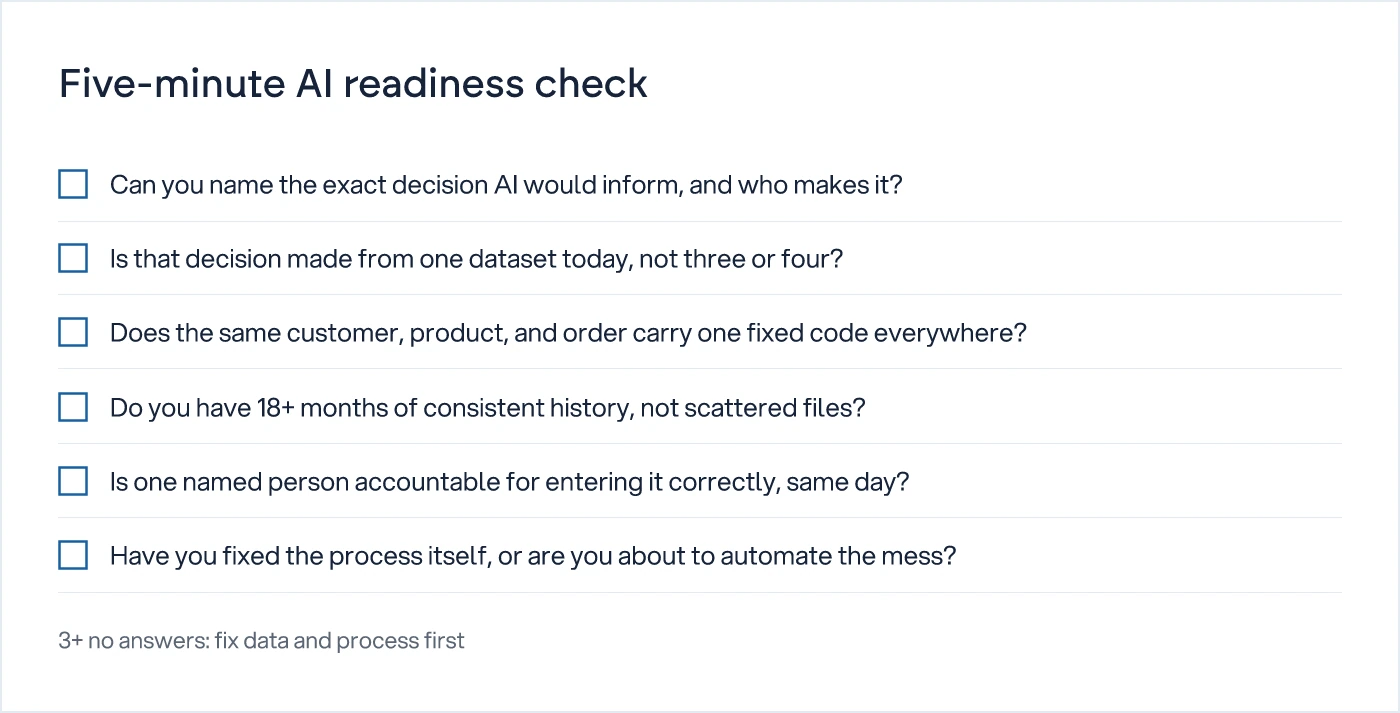
If you answer "no" to three or more of these, the right next step is not a vendor conversation. It is two to three weeks of getting the decision and the data in order internally, then going back to the vendor with a much sharper brief and a much shorter, cheaper engagement.
What happens when AI is layered on a process that's still broken?
The timeline stretches, the cost climbs past the original quote, and the business usually reverts to the old way of deciding within a quarter, having paid for a tool nobody trusts enough to use.
Here is a sequence that plays out often enough to be worth walking through. A mid-size textile trading firm gets pitched a demand-forecasting tool. The pitch is genuinely reasonable: predict which fabric lines will move next month, reduce overstock, free up working capital tied up in slow inventory. The owner says yes.
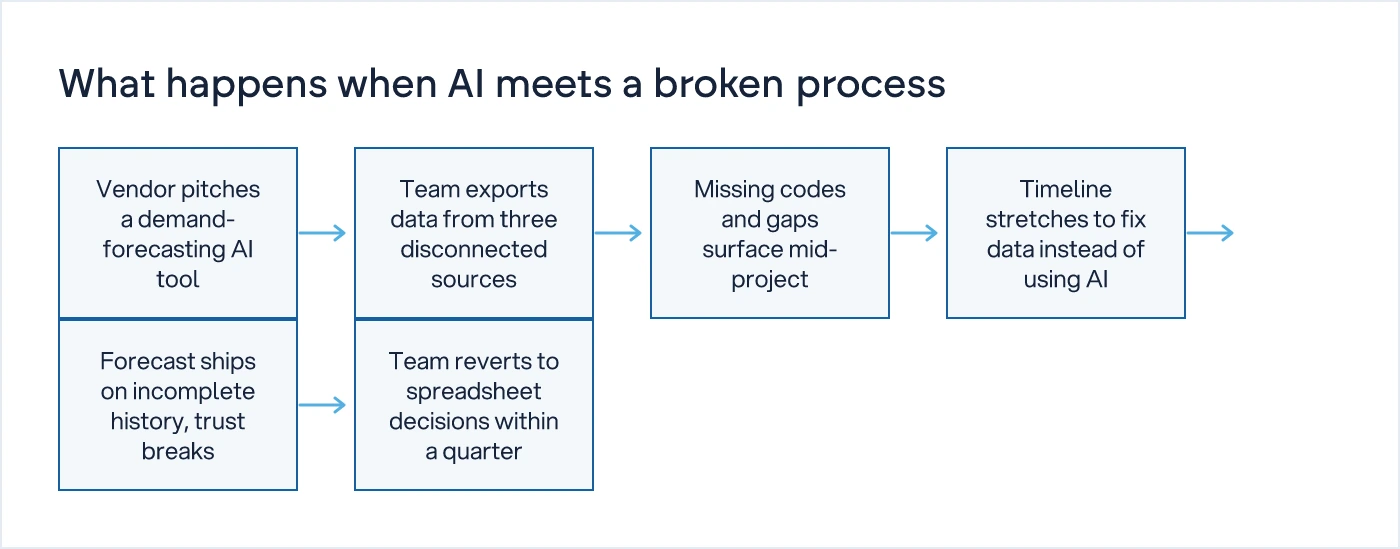
The vendor asks for "your sales history." What exists is a Tally export with inconsistent SKU naming, a WhatsApp group where the sales team logs verbal orders that never make it into Tally the same day, and an Excel sheet the sales manager maintains for his own reference, in his own shorthand, that nobody else has seen. Three sources, three sets of names for the same fifteen products, no shared customer code.
The vendor's team spends the first six weeks reconciling this instead of building the forecast. Historical gaps surface: entire months where WhatsApp orders were never logged anywhere formal. The timeline that was quoted at six weeks becomes four months. The forecast that finally ships is trained on data with real holes in it, so its first few predictions are visibly wrong. The sales team, who never trusted the exercise to begin with, stops checking it. Within a quarter, everyone is back to deciding stock levels from memory and the sales manager's Excel sheet.
Nothing about the AI itself failed here. The decision was never named clearly, the data was never structured, and the process of capturing an order was still broken in three places before the model ever saw it. Do not automate a bad process. Fix how the order gets captured and coded first. The forecasting tool becomes a much smaller, much cheaper problem once that is done, because most of what looked like an AI project was actually a data discipline project wearing an AI label.
What should you do differently before the next vendor pitch?
Run an internal audit first, on your own, using the two lists above. Pick the one decision in your business where a wrong call costs you the most, real money every month, and trace it back to its data source. You will usually find the same three problems: no fixed decision owner, inconsistent identifiers, and history that is shorter and messier than anyone assumed. Those three things are fixable in weeks, without buying anything, and fixing them is what actually determines whether an AI investment pays back or sits unused six months from now.
That audit, done properly, is where a transformation partner should start too. It is a smaller part of what we cover under our digital transformation service, where the first work is always understanding how the decision is made today before any system, AI or otherwise, gets designed around it. For more on how this thinking applies across manufacturing, trading, and service businesses, see the Technology and Trends hub.